The Dove with the Olive Branch as a Symbol of Peace
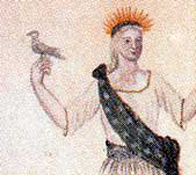 At the time of the American Revolution, the olive branch had a stronger association with peace than did the dove. In fact, a dove was suggested as part of the third committee's design for the Great Seal which specified a natural-colored dove perched on the hand of "the Genius of America." (Shown here is a detail of the actual drawing.) But this dove did not symbolize peace. Instead it was "emblematical of Innocence and Virtue."
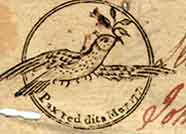
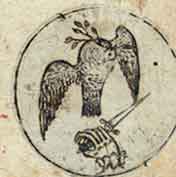
A dove with olive leaves was the emblem on North Carolina's £2 note of 1771 (above left). The accompanying motto meant: "Peace restored." A dove with olive leaves was also on Georgia's $40 note of 1778 (above right) along with a hand holding a dagger. The motto meant: "Either war or peace, prepared for both."
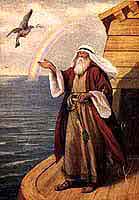 Commentary: The dove and the olive first appeared together in the biblical story of Noah's Ark. But how did this symbolize peace? If you'd been on that Ark for nearly a year, and then saw the dove return with an olive leaf, would peace be the best way to describe your response? More likely, such a sight would trigger joy, hope, gratitude – emotions that would then lead to a sense of being at peace. Here the actual symbol of peace is not the dove. It is the olive leaf.
An early instance the olive branch signifying peaceful intentions is in
Virgil's epic poem about the founding of Rome.
The olive branch is a dynamic symbol of the human desire for peace,
as shown in political drawings before the American Revolution.
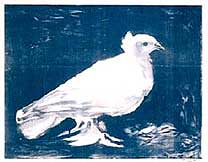
The white dove has become an international symbol of peace, thanks in good part to the fame of Picasso's 1949 lithograph for the International Peace Congress in Paris.
The Great Seal of the United States illustrates a founding principle:
The power of peace is superior to the power of war.
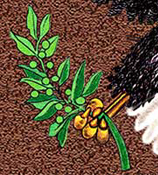
The American Eagle looks toward the olive branch
held in its stronger right talon.
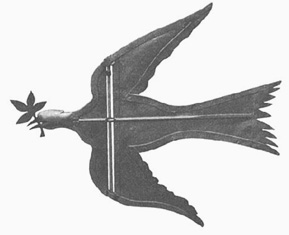 Another place where a dove works better than an olive branch is as a weather vane.
Made in 1787, George Washington's prized weather vane (right) still sits atop his home, Mount Vernon. Shaped as a dove of peace, the bird is 40 inches long with a wingspan of 35 inches.
The weather vane is now covered with gold leaf to deter corrosion of its copper body.
See visions of peace after the Revolution and visit the Temple of Peace.
|