|
Main Pages
Front Page
Overview
Seal FAQs
Design Process
1st Committee
2nd Committee
3rd Committee
Final Design
Description
Explanation
Latin Mottoes
E Pluribus Unum
Annuit Coeptis
Novus Ordo Seclorum
Symbols (front)
Bald Eagle
Shield
Olive Branch
Arrows
Stars
Rays of Light
Cloud
Symbols (back)
Pyramid
Eye
MDCCLXXVI
Great Seals
Official Dies
First Engravings
First Painting
1792 Medal
Indian Medals
1882 Medal
One-Dollar Bill
Myths
Eagle Side
Pyramid Side
Themes
Unity
Peace
Liberty
Thirteen
Related
Wild Turkey
President's Seal
Sightings
Resources
|
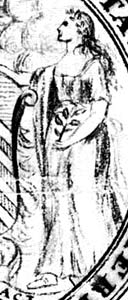
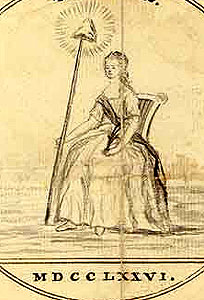
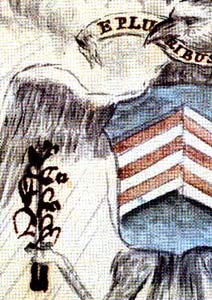
The Olive Branch on the Great Seal
"A Figure representing Peace bearing an Olive Branch" (above left) was suggested in 1780 by the second Great Seal committee. On the reverse side of their design created by Francis Hopkinson, Liberty is seated, holding an olive branch (above center).
Two years later, for the final design of the Great Seal, Charles Thomson put an olive branch in the eagle's right (dexter) talon and faced the eagle toward it. (Detail of Thomson's preliminary sketch is shown above right.)
The official description specifies a bald Eagle "holding in his dexter talon an Olive branch." (The number of olives or leaves is not specified.)

Thomson explained the symbolism: "The Olive branch and arrows denote the power of peace & war which is exclusively vested in Congress."

Olive leaves carried by a dove is also a symbol of peace.
NOTE: In heraldry, the symbol in a figure's right hand has more significance than one in its left hand. Also important is the direction faced by the eagle. All dies of the Great Seal have shown the eagle facing the olive branch. The eagle on the Seal of the President, however, used to face the bundle of arrows.
|
The Great Seal of Peace
Not only does it emphasize the power of peace, but the Great Seal itself was born out of the desire for peace.
In the spring of 1782, there was an urgency to finalize the Great Seal (whose design process had begun six years earlier on July 4, 1776). The United States of America had won their long battle for Independence, and Britain was ready to recognize and treat them as a sovereign nation. A national seal would soon be needed to ratify the peace treaty.
At the end of that summer, the first Great Seal die was cut and used on September 16, 1782 to begin sealing the peace with England – on a document authorizing General Washington to negotiate with the British and sign an agreement for the exchange, subsistence, and better treatment of prisoners of war.
Indian Peace Medals given by President Washington
contain some of the best realizations of the Great Seal.
|
"After much occasion to consider the folly and mischiefs of a state of warfare, and the little or no advantage obtained even by those nations who have conducted it with the most success, I have been apt to think that there has never been, or ever will be, any such thing as a good war, or a bad peace." – Benjamin Franklin to Jonathan Shipley, June 10, 1782
For an eloquent expression of the Great Seal's war and peace symbolism,
see President Obama's 2009 Nobel Peace Prize lecture.
|
